
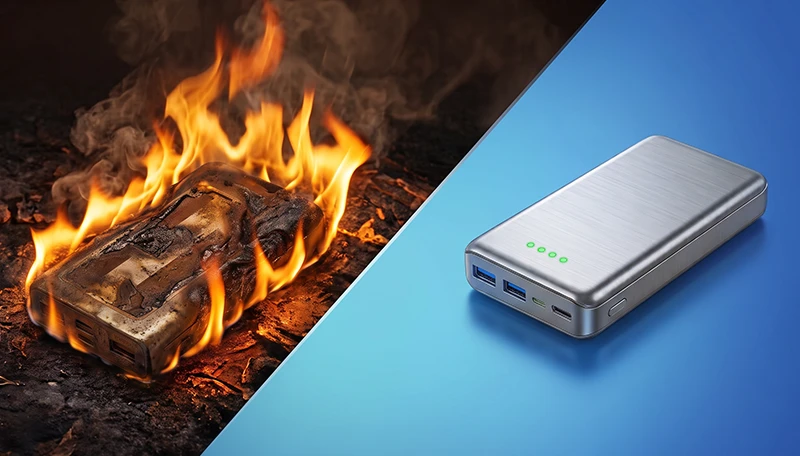
1. What is China's New Safety Standard "GB 47372-2026" for Power Banks?
Announced in China in spring 2026, GB 47372-2026, the Safety Technical Specification for Power Banks, is a new national standard that sets safety requirements for power banks and portable power stations. Formulated to prevent battery fire incidents, which have occurred frequently in recent years, and to eliminate inferior products from the market, it will be fully enforced in April 2027.
Considered the most stringent standard to date, its most prominent feature is the significant strengthening of tests such as overcharge and thermal abuse, along with the mandatory "nail penetration test," which requires the cell not to ignite or explode even when pierced by a steel nail. The standard also introduces dual protection circuits and traceability via unique identification codes.
The enforcement of GB 47372-2026 will not immediately change national safety certification standards in each country *1, but many power banks and portable power stations currently distributed worldwide are manufactured in China. Therefore, this regulation is expected to ripple through the global market, bringing about major changes such as improving overall product safety, eliminating dangerous cheap alternatives, and normalizing prices.
2. Background and Overview of the Formulation of "GB 47372-2026"
2-1. Background of the Formulation of "GB 47372-2026"
China is the world's largest producer and consumer of power banks (充电宝) and portable power stations (outdoor power stations). The reason why a standard considered the strictest in history has become necessary is the growing severity of the following problems in recent years:
Frequent Fire Incidents and Recalls
With the rapid expansion of the power bank market, fire and explosion incidents caused by inconsistent quality and cheap, inferior products have occurred frequently. Repeated large-scale product recalls, including those by major brands, and stricter restrictions on carry-on luggage on airplanes have become social issues.
Existing general safety standards and "3C Certification" alone have not been able to completely eliminate risks arising from harsh usage environments and abuse scenarios that exceed conventional standards, such as exposure to high temperatures, overcharging, dropping, and crushing.
In response to this situation, under the initiative of Chinese government agencies, including the Ministry of Industry and Information Technology (MIIT), the extremely strict new standard "GB 47372-2026" was formulated, aiming to "improve the intrinsic safety" of power banks and normalize the market (eliminate inferior products).
2-2. Overview of the Enforcement of "GB 47372-2026"
- Scope of Application:
- Portable battery-equipped devices capable of supplying power to other devices, such as power banks.
Note: Small charging cases, such as those for TWS (True Wireless Stereo) earphones, are classified as devices with mobile power functions if the total rated capacity of the internal battery exceeds 600mAh.
- Portable battery-equipped devices capable of supplying power to other devices, such as power banks.
- Basic Specification Conditions:
- Rated input voltage: AC 220V (*including devices with 220V in their operating range) and/or DC 250V or less
- Output voltage: DC and/or AC
- Mass: 18kg or less
- Product Classification:
Product classification is defined by the total rated energy of the internal battery.
- Portable mobile power supplies (e.g., power banks): 160Wh or less
- Portable energy storage power supplies (e.g., outdoor power stations): Over 160Wh
- Date of Promulgation: March 31, 2026 (Official announcement on April 3)
- Date of Full Enforcement: April 1, 2027 (Sale of non-compliant products will be prohibited thereafter)
- Transition Period: 12 months
Note: After April 1, 2027, the manufacture, sale, and import of products that do not comply with this new standard will be strictly prohibited within China. As of 2026, manufacturers are rushing to ensure compliance by utilizing the one-year transition period.
3. Compliance with "GB 47372-2026": Key Points for Power Bank Circuit Designers
The reason this standard is called the "strictest power bank regulation in history" lies in the increased severity of its tests and the addition of new safety requirements. Power bank circuit designers must understand the following key points of the tightened regulations.
Key Points of Tightened Regulations in "GB 47372-2026"
(1) Significant Strengthening of Test Criteria
The cells, which are the core components of batteries, are subjected to tests that are more severe than conventional ones, as shown below:
- Overcharge test: The charging voltage has been increased to 1.3 times the previous standard.
- Crush test: The applied crush force has been increased from the conventional 13.0kN (±0.78kN) to 20kN (±1.2kN) *2.
- Thermal abuse test: The test temperature has been raised from 130°C to 135°C.
(2) Introduction of the "Nail Penetration Test"
This test uses a high-temperature-resistant steel nail (e.g., tungsten steel, with a cone angle of 14° at the tip) with a diameter of 4mm, driven vertically into a fully charged battery cell (single cell) at a speed of (20 ± 1) mm/s. This test is mandated to evaluate the safety of the battery cell in isolation, rather than relying on protection from the pack or module structure. The condition for passing is that the nail completely penetrates the cell, and the cell remains in that state for 5 minutes without igniting or exploding. This is an extremely strict requirement that can only be cleared by batteries equipped with an inherently safe cell-level design capable of withstanding the most severe internal short-circuit conditions.
(3) Countermeasures for Long-term Use (Aging/Degradation)
Lithium Plating Detection After Battery Aging
Charge/discharge cycles are repeated under specific conditions. If the total discharge capacity is less than 225C (225 times the rated capacity C) at 300 cycles, the charge/discharge cycles are continued until reaching 225C. This checks whether the risk of metallic lithium plating, which causes internal short circuits, is low.
(4) Stricter Circuit Design and Protection Functions (Dual Protection, Disablement, Temperature Control)
The standard mandates strict voltage and temperature monitoring and control designs that go beyond what conventional protection circuits can achieve.
- Adoption of Dual Protection Circuits (Single Fault Condition Compliance)
The standard mandates the installation of a "dual protection circuit" separate from the existing protection circuit. Similar to UL standards and IEC 62368-1 *3, redundancy is required to ensure that the protective operation functions reliably even if a single component fails (single fault condition). - Implementation of Disablement Function During Abnormalities (Fail-safe)
In the event of abnormal high voltage (overvoltage) or abnormal low voltage (undervoltage), products are required to be equipped with a fail-safe function that not only stops operation but also safely disables the product (prohibits charging and discharging). - Setting the Charge/Discharge Temperature Range
Strict temperature control (BMS) is required to physically prevent charging and discharging outside the temperature range specified by the battery cell manufacturer.
(5) Mandating Intelligent Management Functions and Traceability (Unique Identification Code)
The device must also record and retrieve information when an abnormality occurs. Furthermore, a unique identification code, essentially acting as an "identity card," must be clearly marked on each power bank, such as by laser engraving. Consumers will be able to trace reliable information, such as the brand of the internal battery cell, from this code.
In addition to the above, requirements for charge voltage derating control to account for aging and increased charge/discharge cycles, input/output port short-circuit protection, and input/output port misconnection protection have also been strengthened.
While we have introduced only a portion of the typical changes described above, the overall standard's requirements are not limited to these. Overall, power bank safety is improving through more comprehensive, stricter testing than before.
4. Lithium-ion Battery Protection Circuit Solutions Provided by ABLIC
ABLIC has over 30 years of experience providing lithium-ion battery protection ICs for battery-equipped devices, including smartphones and power tools. Leveraging robust hardware-based battery protection circuit technologies that we've cultivated through developing lithium-ion battery protection ICs for smartphones, including dual protection and fast-charging support, we propose smart battery protection circuits to comply with GB 47372-2026.
(1) Adoption of Dual Protection Circuits (N-ch Tr Low-side Protection)
Recommended Product: 1-Cell Battery Protection ICs S-82K1B Series
(2) Adoption of Dual Protection Circuits (N-ch Tr High-side Protection)
Recommended Product: 1-Cell Battery Protection ICs S-821A Series
(3) Implementation of Disablement Function During Abnormalities (Undervoltage Lockout by 0V Battery Charge Prohibition)
To prevent the risk of ignition caused by charging a battery that has fallen into an overdischarged state, products must be equipped with a fail-safe function that irreversibly prohibits (disables) charging and discharging during an abnormal low-voltage condition.
Test conditions in the standard: At the time of test judgment, an overdischarged state of "battery discharge end voltage × 0.4" is applied, and the test verifies whether the product can reliably maintain a charge/discharge prohibited (lockout) state under that voltage *4.
In actual product design, the following items must be determined and considered based on each manufacturer's design philosophy:
- Definition of the reference voltage (whether to use the setting value on the system BMS side or the overdischarge detection voltage of the battery protection IC).
- Setting the multiplier and threshold value (0V battery charge prohibition voltage) to trigger disablement.
Note that the specific requirements regarding higher voltage and higher precision of the 0V battery charge prohibition voltage will differ depending on the IC product series adopted. When selecting the optimal protection IC and circuit design, please contact our sales representatives.
(4) Implementation of Disablement Function During Abnormalities (Charge/Discharge Prohibition After Abnormal High Voltage)
Test conditions in the standard: If the voltage reaches or exceeds the battery charge upper limit voltage + 0.3V, charging and discharging must be prohibited *4. Even if the voltage of the battery cell drops, this charge/discharge prohibition must be maintained.
Recommended Products
- 1-Cell Battery Protection ICs (For Secondary Protection) S-8206A Series
- 1-Cell Battery Protection ICs S-82K1B Series
(5) Setting the Charge/Discharge Temperature Range
Charging outside the range of the upper limit charge temperature (Tcm) and lower limit charge temperature (Tcl), and discharging above the upper limit discharge temperature (Tdm) specified by the battery cell manufacturer must be prohibited. Verification tests are conducted at temperatures 4°C beyond these specified limits (e.g., Tcm + 4°C, Tcl - 4°C, and Tdm + 4°C).
Recommended Products
- 1-Cell Battery Protection ICs with Temperature Protection Function S-82D1A Series
- 1-Cell Battery Protection ICs S-82K1B Series
Inquiries
We can also propose the optimal protection circuit configuration from our lineup to meet various customer requests. Please contact our sales representatives.
*1. Products sold in each country must comply with the safety technical standards stipulated by each respective country or region (e.g., CE in Europe, UL in the US, PSE in Japan, etc.) independently of compliance with the GB standard.
*2. For cylindrical and prismatic cells: Cylindrical cells are crushed from a direction perpendicular to the longitudinal axis (side). Prismatic cells are crushed perpendicularly to the surface with the largest area. For details on other shapes and tests, please refer to the official text of the standard.
*3. Major safety standards related to dual protection (compliance with single fault condition): Similar redundant designs are also required in safety standards specific to lithium-ion batteries, such as the safety standard for lithium batteries for portable equipment (IEC 62133-2) and the UL standard for device and portable batteries (UL 2054).
*4. Manufacturer setting conditions: The voltage conditions that trigger disablement in product design are determined by each manufacturer's own product design philosophy.
[Disclaimer]
This content is provided as general reference information based on the Chinese national standard "GB 47372-2026" as of the date of creation. While we strive for accuracy, we do not guarantee its completeness or currency. In addition, the content of this material may be updated without notice. For actual product/service standard compliance and legal judgments, please be sure to check the latest official text of the standard and make verifications and judgments at your own risk. We shall not be held responsible for any damages arising from the use of this document.
Reference standards: GB 47372-2026, GB 31241-2022
Date of Creation: August 1, 2026