
Table of Contents
Moving beyond simple failure prevention, leak detection is now a cornerstone of Business Continuity Planning (BCP).
This guide explores the rising risks of water damage and provides a roadmap for selecting the most reliable, cost-effective sensing solutions for your facility.
The Growing Necessity of Industrial Water Leak Detection
In the past, the mainstream approach to water leaks was "fix it when it happens." However, in today's social infrastructure and business environment, the associated risks have reached a level that cannot be ignored.
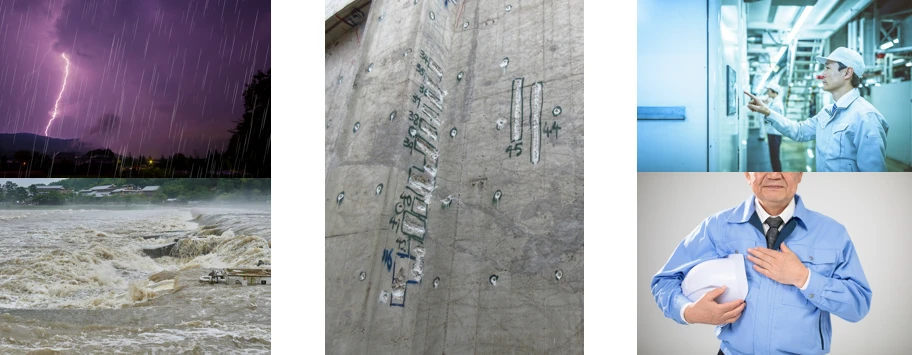
Increasingly Severe Weather Disasters
Flood damage from torrential rains and large typhoons has become common. Protecting critical equipment in basement facilities and on lower floors is more important than ever.
Aging Infrastructure
As sewage pipes buried during periods of high economic growth exceed their service life, road subsidences and bursts in building pipes are increasing rapidly.
Increase in Water-Cooled Data Centers
To cool high-heat servers driven by AI demand, there is a shift from traditional air cooling to "water cooling." Any water leak could lead to fatal losses, such as data destruction or total system shutdown.
Labor Shortages and Management Costs
With a shortage of maintenance personnel for building inspections, there is an urgent need to transition to "automated monitoring" that does not rely on visual checks.
How to Choose the Right Industrial Leak Sensor
5 Key Factors for Selecting Industrial Water Leak Sensors
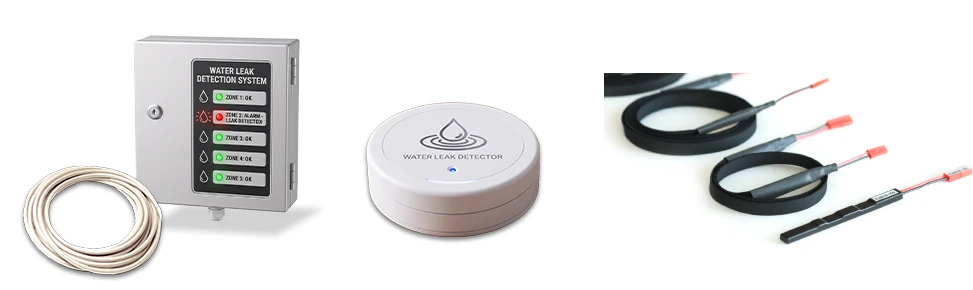
The "ideal" sensor depends entirely on your environment. Here are the five critical criteria to ensure your facility remains protected.
1. Choosing by Installation Site
| Type of Sensor | Recommended Location | Advantage | Limitations |
|---|---|---|---|
| Point Sensor | Floors, directly under equipment | Cost-effective for localized monitoring. | Limited detection range. |
| Sensor Ribbon | Long pipes, behind ceilings | Covers wide areas and complex routes. | Susceptible to physical damage, requires more effort to install. |
2. Selecting Based on Liquid Type

Tap Water / Industrial Water
Can be handled by standard sensors that utilize the electrical conductivity of the water.
Non-conductive Liquids (Pure Water, Ultrapure Water, Oil, etc.)
Since pure water and oils used in semiconductor factories do not conduct electricity, they are difficult to detect with general ribbon sensors. Specialized high-sensitivity or optical sensors are required.
Chemicals, etc.
Detectability varies depending on the sensor and the specific chemical. Pre-verification is required.
3. Evaluating Power Source Options
The power supply method determines the effort required for installation and operation.
| Power Supply Method | Advantage | Limitations |
|---|---|---|
| AC Power (Wired) | Stable operation. No worry about batteries. | Requires outlets and electrical construction work. |
| Battery-powered | Can be placed anywhere. Easy installation. | Requires periodic battery replacement. Risk of battery leakage or depletion. |
4. Comparing Connectivity & Alerts
Wired System
Highly reliable, but generally assumed to be installed during the design/construction phase of a building. Retrofitting to existing facilities requires large-scale construction (e.g., drilling through walls), which significantly increases costs.
Wireless System
Easy to retrofit to existing facilities without construction. However, challenges include communication distance, the impact of obstacles, and "how to secure a power source for the wireless device."
5. Budget and Timeline Considerations
Wired System
High costs—ranging from tens of thousands to hundreds of thousands of dollars—due to extensive cabling and wiring work.
Extended timelines, often taking anywhere from one to several years from initial planning to full deployment.
Wireless System
Relatively low costs—ranging from hundreds to several thousand dollars—making it a highly economical solution.
Rapid deployment timelines, allowing full implementation in just a few days to a few weeks.
Wireless. Batteryless. Effortless. ABLIC's CLEAN-Boost™ Batteryless Water Leak Sensor
"Wiring work is too expensive for our budget. But we don't have the manpower for battery maintenance either..."
ABLIC's CLEAN-Boost™ Batteryless Water Leak Sensor is the solution to these pressing onsite concerns.
Meet ABLIC's CLEAN-Boost™: The Future of Maintenance-Free Leak Detection
Zero Battery Maintenance
Powered by the leak itself. No replacements, ever.
Hassle-Free Wireless
Eliminates the need for costly cabling and complex retrofitting.
Precision Sensitivity
Detects as little as three drops to stop disasters before they start.
Set-and-Forget Reliability
Active and ready for 10+ years without intervention.
How Can "Water" Generate Electricity?
Using CLEAN-Boost™ technology developed through joint research with Ritsumeikan University, extremely weak energy obtained from water is efficiently stored and boosted. This enables wireless transmission without the need for batteries.