
Batteryless Water Leak Sensor - Optional Product
Alive Monitoring Timer
This optional product performs alive monitoring to detect failures in batteryless water leak sensor, wireless communication issues, system malfunctions, and other problems.
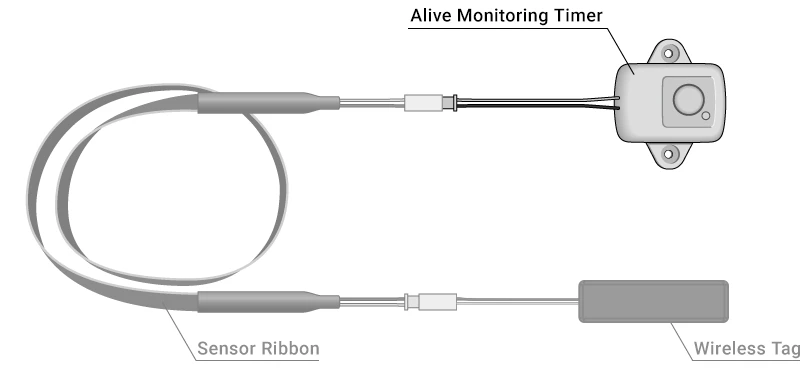
What is an alive monitoring timer?
The batteryless water leak sensor is a system that does not operate unless it absorbs water, making it impossible to determine whether it is in a normal state or a malfunction state while waiting for a leak. The alive monitoring timer is an optional product developed to facilitate alive monitoring of both the batteryless water leak sensor and the receiver system.
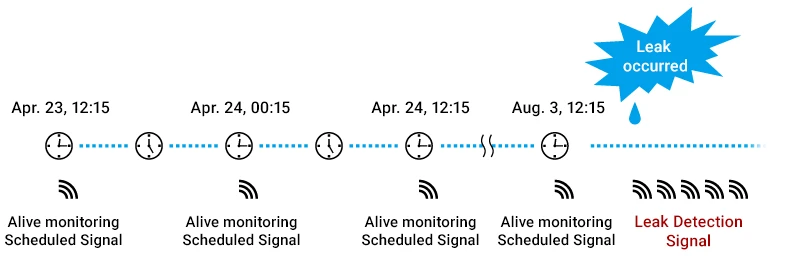
By periodically supplying a low-power signal from the alive monitoring timer to the batteryless water leak sensor, the sensor is activated. This enables monitoring of the entire system's operational status, contributing to labor savings in tasks such as inspections.

Features
- Performs alive monitoring of both the wireless tag and the sensor ribbon to detect failures.
- Connects to the connector at the terminal of the sensor ribbons.
- No external power required for flexible layout
- 10-year operation with CR2032 battery, powered by low current consumption technologies. (typical calculation result; battery manufacturer's recommended lifespan = 5 years)
- Low battery notification (switches notification cycle from 12 hours to 6 hours)
- Ordinary-use waterproof design (water-resistant under normal conditions)
Specifications
| Alive Monitoring Timer | S-CBAMAAAC |
|---|---|
| Dimensions | 135×59.4×13 mm (Main body: 49.1×59.4×13 mm) |
| Battery Type | CR2032 |
| Operation temperature | -10℃ to +50℃ |
| Operation humidity | 95%RH max. |
| Water Resistance | Ordinary-use waterproof |
Detectable Failure Modes
- Failure of the wireless tag
- Disconnection and short circuit of the sensor ribbon
- Failure of transmission and reception between the wireless tag and the receiver system
- Failure of the receiver system
- Connector disconnection and contact failures
- Disconnection and short circuit due to connector corrosion, etc.
- Disconnection and short circuit of lead wire
Global Sales Offices
EEA and other CE-compliant countries

NMB-Minebea-GmbH
Siemens Str. 30, D-63225 Langen, GermanyUnited States

ABLIC U.S.A. Inc.
200 Pine Ave. Suite 514, Long Beach, CA 90802, U.S.A*The batteryless water leak sensor is a joint development product with Taisei Corporation.
**The Accumulation and Boosting voltage circuit is a joint development between ABLIC Inc. and Ritsumeikan University
Bluetooth® is a registered trademark of Bluetooth SIG, Inc.
LoRa® is a trademark of Semtech Corporation.This product complies with FCC and CE marking requirements.
Available for sale in: United States, European Economic Area (EEA), Switzerland, Turkey, Japan.